
Alcoholics Anonymous is an international fellowship of men and women who have had a drinking problem. It is nonprofessional, self-supporting, multiracial, apolitical, and available almost everywhere. There are no age or education requirements. Membership is open to anyone who wants to do something about his or her drinking problem.
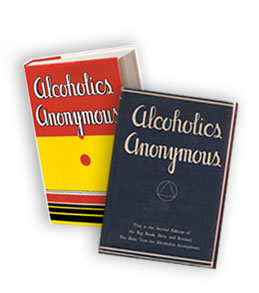
Our main book is called Alcoholics Anonymous, which is how and where our society got its name
Since the book Alcoholics Anonymous first appeared in 1939, the basic text (the pages up to 164) has not been changed in the editions published in 1955 (2nd), 1976 (3rd), and 2001, (4th). This is the basis of our service work and has helped millions of men and women to recover from alcoholism.
The Twelve Steps
A.A.’s Twelve Steps are a group of principles, spiritual in nature, which, if practiced as a way of life, can expel the obsession to drink and enable the sufferer to become usefully happy and whole.
- We admitted we were powerless over alcohol – that our lives had become unmanageable.
- Came to believe that a Power greater than ourselves could restore us to sanity.
- Made a decision to turn our will and our lives over to the care of God as we understood Him.
- Made a searching and fearless moral inventory of ourselves.
- Admitted to God, to ourselves, and to another human being the exact nature of our wrongs.
- Were entirely ready to have God remove all these defects of character.
- Humbly asked Him to remove our shortcomings.
- Made a list of all persons we had harmed and became willing to make amends to them all.
- Made direct amends to such people wherever possible, except when to do so would injure them or others.
- Continued to take personal inventory and when we were wrong promptly admitted it.
- Sought through prayer and meditation to improve our conscious contact with God as we understood Him, praying only for knowledge of His will for us and the power to carry that out.
- Having had a spiritual awakening as the result of these steps, we tried to carry this message to alcoholics and practice these principles in all our affairs.
The Twelve Traditions
A.A.’s Twelve Traditions apply to the life of the Fellowship itself. They outline the means by which A.A. maintains its unity and relates itself to the world about it, the way it lives and grows.
1. Our common welfare should come first; personal recovery depends upon A.A. unity.
2. For our group purpose there is but one ultimate authority — a loving God as He may express Himself in our group conscience. Our leaders are but trusted servants; they do not govern.
3. The only requirement for A.A. membership is a desire to stop drinking.
4. Each group should be autonomous except in matters affecting other groups or A.A. as a whole.
5. Each group has but one primary purpose — to carry its message to the alcoholic who still suffers.
6. An A.A. group ought never endorse, finance, or lend the A.A. name to any related facility or outside enterprise, lest problems of money, property, and prestige divert us from our primary purpose.
7. Every A.A. group ought to be fully self-supporting, declining outside contributions.
8. Alcoholics Anonymous should remain forever non-professional, but our service centers may employ special workers.
9. A.A., as such, ought never be organized; but we may create service boards or committees directly responsible to those they serve.
10. Alcoholics Anonymous has no opinion on outside issues; hence the A.A. name ought never be drawn into public controversy.
11. Our public relations policy is based on attraction rather than promotion; we need always maintain personal anonymity at the level of press, radio, and films.
12. Anonymity is the spiritual foundation of all our traditions, ever reminding us to place principles before personalities.
 There Is A Solution Group